Information technology · Software engineering
WeQ Sports
GmbH
We design, build and maintain software systems — custom applications, web platforms, cloud infrastructure and the integrations that hold them together. Engineering treated as precision work: specified carefully, built in increments, tested continuously.
Custom software
Web platforms
Cloud architecture
Integration
Product design
Quality assurance

02The company
An engineering company for software that has to keep running.
WeQ Sports GmbH works in information technology, software engineering and digital solutions. Our focus is systems that are used daily and must remain understandable, maintainable and safe to change long after the first release.
We describe what we propose to build before we build it, keep the amount of work in progress small, and make each increment reviewable. That approach suits organisations replacing manual processes, connecting systems that were never designed to talk to each other, or rebuilding software that has outgrown its original design.
The pages that follow set out our capabilities and delivery approach. They describe how we intend to work with clients rather than making claims about past results.

03Capabilities
Software engineering, end to end.
Our capabilities cover the full life of a system: understanding the problem, designing the solution, writing the software, running it in production and changing it safely afterwards.
- 01Discovery and specification
- Structured conversations, review of existing systems and written specifications that describe scope, constraints, data and expected behaviour before implementation begins.
- 02Architecture
- Service boundaries, data models, failure behaviour and deployment topology chosen for the actual load and team size, and recorded in decision notes that explain the reasoning.
- 03Implementation
- Application and backend development in mainstream languages and frameworks, with code review, automated tests and continuous integration as standard practice.
- 04Operations enablement
- Build pipelines, environment configuration, logging, metrics and alerting, so that a system can be observed and diagnosed by the people who run it.


04Capability
Custom software development
Software written for a specific operating reality, where an off-the-shelf product would force the organisation to work against its own process.
Custom development is appropriate when the process being supported is a genuine differentiator, when data must remain under the organisation’s control, or when several tools are being held together by manual effort. We start from the workflow as it is actually performed, model the domain in plain language, and only then decide on structure and technology.
- Typical scope
- Internal operational tools, data entry and review applications, reporting and calculation engines, scheduling and tracking systems, back-office services.
- Approach
- A thin end-to-end slice first, then depth. Each increment is deployable, covered by tests and reviewed against the written specification.
- Possible deliverables
- Source code and repository history, automated test suite, build and deployment configuration, architecture and operations documentation.
05Capability
Web applications and digital platforms
Browser-based systems that hold up under real use: predictable on slow connections, usable on small screens, and accessible to people using assistive technology.
Front-end engineering
Component architecture, state management, form and validation design, and rendering strategies chosen for the content — server-rendered where search visibility and first paint matter.
Platform services
Authentication and permissions, multi-tenant data separation, background processing, file handling, auditing and administrative interfaces.
Performance and accessibility
Budget-driven asset delivery, responsive images, semantic markup, keyboard operability and contrast checked as part of development rather than after it.
06Capability
Cloud architecture and infrastructure
Environments that can be rebuilt from their definition, observed while running, and changed without guesswork.
We favour infrastructure described as code, deployments that are repeatable and reversible, and configuration that is explicit rather than discovered. Sizing follows measured demand; cost is treated as a design constraint alongside reliability. Where a workload does not benefit from distribution, we keep it simple rather than adding services for their own sake.
- Typical scope
- Environment design, container and runtime configuration, networking and access boundaries, data storage and backup strategy, deployment pipelines, monitoring and alerting.
- Possible deliverables
- Infrastructure definitions, environment documentation, deployment runbooks, dashboards and alert rules, and a recovery procedure that has been rehearsed.
07Capability
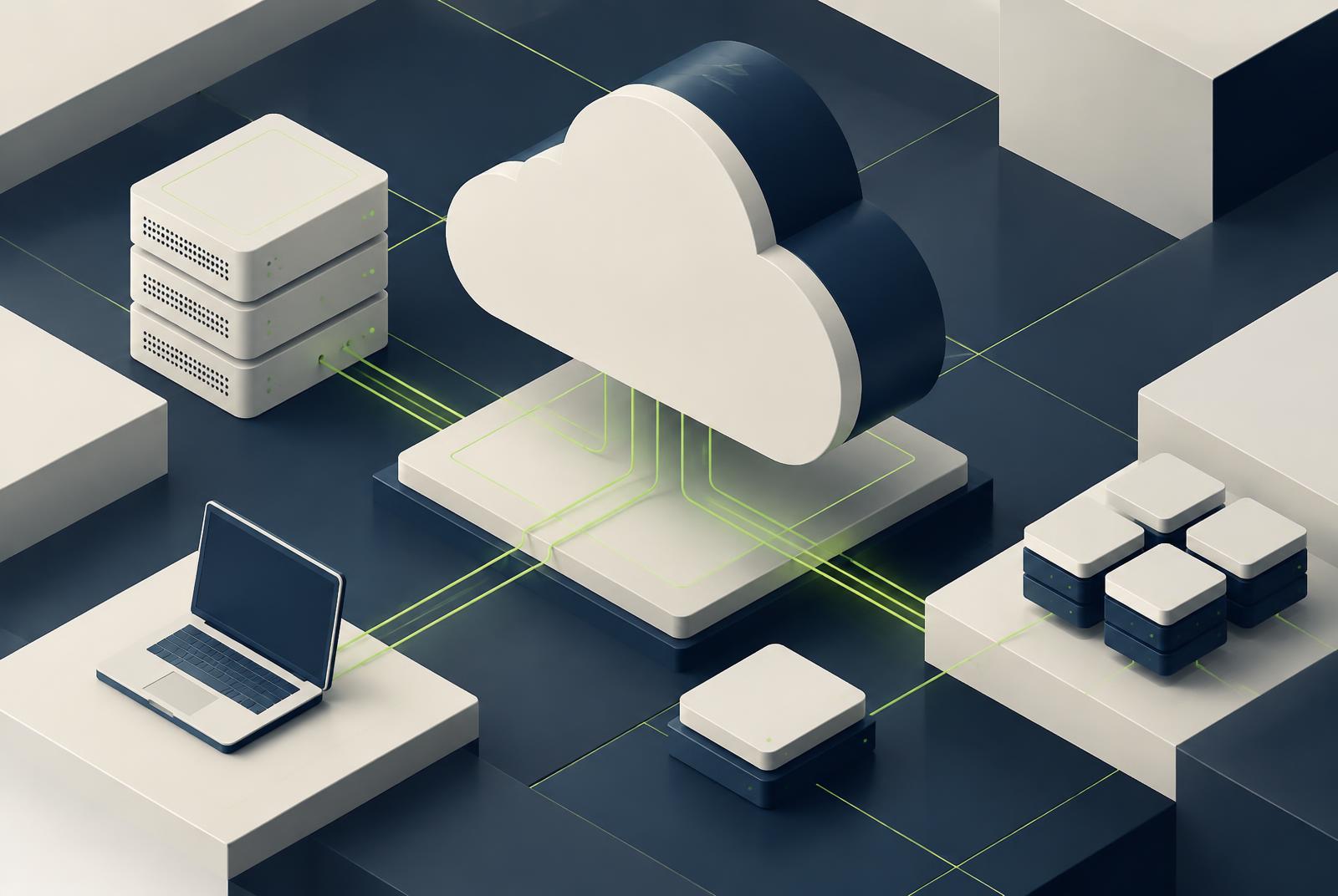
Systems integration and workflow automation
Most organisations do not need another application. They need the applications they already have to exchange data reliably and without human re-entry.
Integration work begins with a map: which system is the source of truth for each entity, how records are identified across systems, what happens when a message is delivered twice, and which failures a human must be told about. Only once that is agreed do we build connectors, transformations and schedules.
Automation follows the same discipline. A manual step is automated when its rules are stable and its failure mode is understood — otherwise it is documented, measured and left in human hands until it is.
- Interfaces
- REST and webhook interfaces, message queues, scheduled batch transfers, file-based exchange with legacy systems.
- Reliability
- Idempotent operations, retries with backoff, dead-letter handling, reconciliation reports and traceable message history.

08Capability
Product design and usability
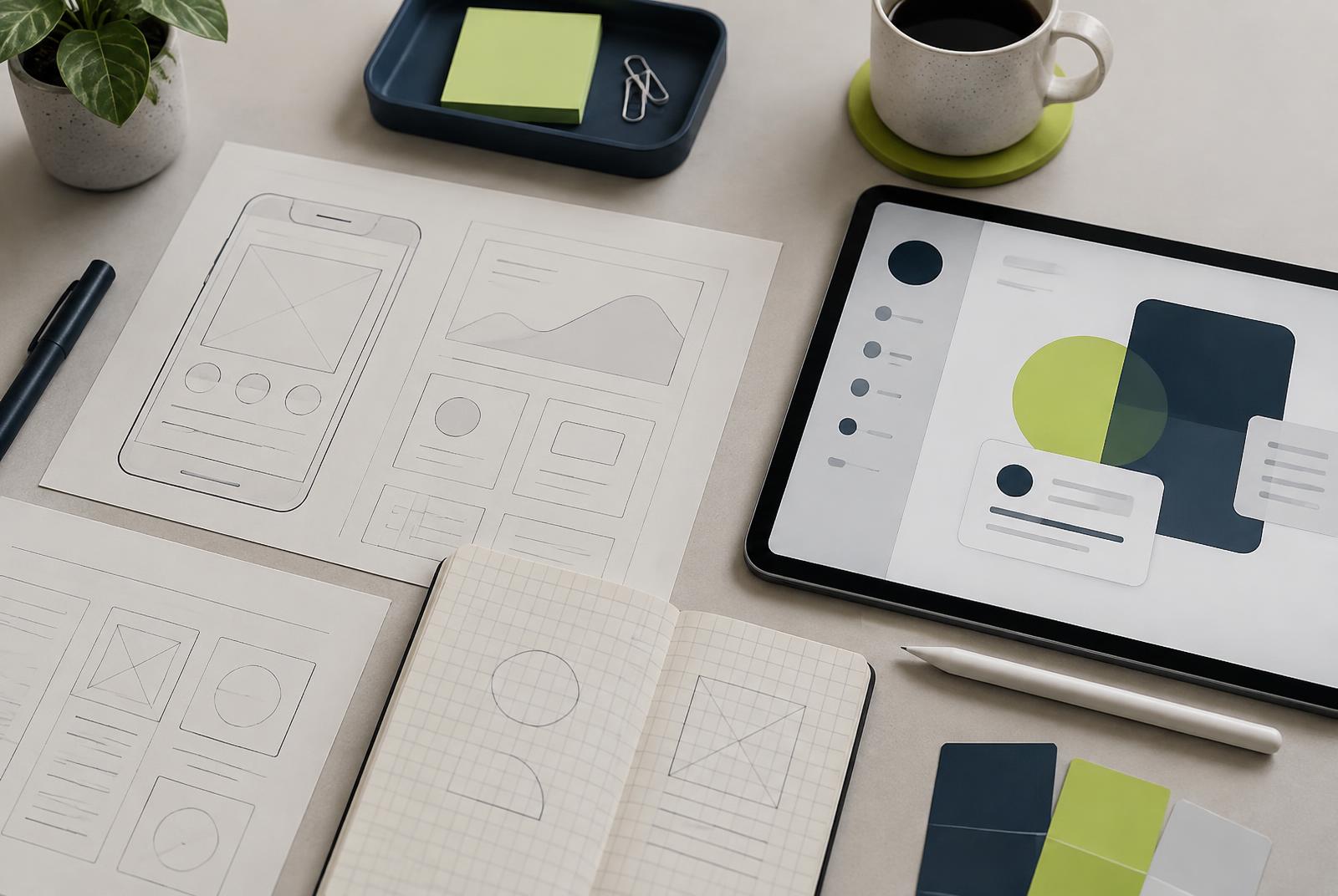
Design that reduces the number of decisions a user has to make, and the number of ways a task can go wrong.
We treat interface design as part of engineering rather than a layer applied at the end. Work moves from task analysis to information architecture, then to low-fidelity flows that can be discussed cheaply, and only then to visual design and a reusable component set. Accessibility requirements — contrast, focus order, keyboard operation, meaningful labels — are stated as acceptance criteria.
- Possible deliverables
- Task flows, wireframes, interface specifications, a component library with defined states, and written accessibility criteria for each screen.
09Capability
Quality assurance and testing practices
Testing is how we keep the cost of change low. It is written with the feature, not scheduled after it.
- 01Automated tests
- Unit tests around logic and calculations, integration tests across service and database boundaries, and end-to-end tests for the small number of journeys that must never break.
- 02Continuous verification
- Every change runs the suite in a pipeline, with static analysis and dependency checks, before it can be merged or deployed.
- 03Exploratory and acceptance testing
- Structured manual sessions against the written specification, including edge cases, permission boundaries and error paths that automation does not cover well.
- 04Defect handling
- Reproduction first, then a failing test, then the fix — so that the same defect cannot return unnoticed.

10Method
How a project is delivered
A sequence intended to surface disagreement early, while it is still inexpensive to resolve.
Step 01
Inquiry and framing
You describe the problem by email. We ask questions about context, users, existing systems and constraints, and confirm whether the work is a good fit.
Step 02
Discovery
A focused review of processes, data and interfaces, producing a written problem statement, a scope outline and the known risks.
Step 03
Specification and plan
Scope broken into increments with acceptance criteria, an architecture outline, and an agreed definition of done for each increment.
Step 04
Build increments
Short cycles producing working, tested software. Each cycle ends with a demonstration, updated documentation and a re-planned backlog.
Step 05
Verification and release
Acceptance testing against the criteria, performance and accessibility checks, deployment rehearsal, then a release with a rollback path.
Step 06
Handover and support
Source code, documentation and operational runbooks transferred, with an agreed arrangement for maintenance, monitoring and further changes.
11Principles
Engineering principles and collaboration
How we prefer to work, stated plainly, so that expectations can be checked against it.
- 01Write it down
- Decisions, trade-offs and assumptions are recorded where the code lives. A system nobody can explain is an unfinished system.
- 02Small, reversible steps
- Changes are kept small enough to review carefully and undo quickly. Large rewrites are avoided unless there is no safe incremental path.
- 03Boring where it counts
- Mature, well-documented technology is preferred for load-bearing parts of a system. Novelty is reserved for places where it earns its risk.
- 04Design for the people who operate it
- Logs, metrics, error messages and runbooks are treated as product features, because they determine how a system behaves on a bad day.
- 05One conversation, not two
- A single shared backlog, direct access to the engineers doing the work, and a written summary after every planning or review session.
- 06Say what is uncertain
- Estimates carry their assumptions. When something is unknown we say so and propose the cheapest way to find out.
12Questions
Frequently asked questions
All answers are shown in full.
What kind of work does WeQ Sports GmbH take on?
Software engineering work: custom applications, web platforms, backend services, cloud environments, integrations between existing systems, and the design and testing that surround them. Engagements can cover a full build or a defined part of one.
How does an engagement usually begin?
With a written description of the problem. From there we work through goals, constraints, existing systems and the shape of a first deliverable, and put that understanding in writing before development starts.
Do you work with existing codebases?
Yes. Alongside new development we take on maintenance and modernisation: reading an existing system, documenting how it behaves, stabilising it, and changing it in increments that can be reviewed and reversed.
Which technologies do you use?
We select mainstream, well-supported technologies appropriate to the problem rather than applying a fixed stack. Where a system already exists, we prefer to stay close to its established technology choices unless there is a clear reason to move.
How is progress shared during a project?
Through working software at short intervals, a visible backlog, and written notes on decisions and trade-offs. Documentation is produced alongside the code, not retrofitted at the end.
Who owns the resulting code?
Ownership, licensing and handover are agreed in writing at the start of an engagement. Our default position is that clients receive the source code and the documentation required to run and extend it.
How can a project inquiry be sent?
By email to [email protected]. A short description of the problem, the systems involved and the outcome you are aiming for is enough to begin a conversation.
13Company information
WeQ Sports GmbH
Project inquiries are received by email. Please include a short description of the problem, the systems involved and the outcome you are aiming for.